Saturday, August 6, 2011

Onions and Kale

I ought to give my onions more time to mature, but I really need the spot for my kale. So a week ago after a wind storm knocked down a large section of them, I went out and knocked down the rest.

Then on Friday I pulled them all out to dry for a day. I wanted to get them out then because there was possible rain all weekend long. Just what the onions didn't need. I just loved how they looked lying out on Friday.

Redwing and Copra on the sheet, Alisa Craig in the corner

But they couldn't stay there. I had to bring them in out of the rain to finish curing. I'm guessing my husband isn't all the pleased about me keeping them in the dining room to dry. But I lack a garage and the shed is too small.

In past years I've always had bad onion harvests. I was lucky to get an onion that was 2" in diameter. This year I'm very happy with my harvest. I wonder how long those onions will last.

Now I removed those onions for a reason. The kale in their newspaper pots was getting really big and had to get planted.

So this morning before work I was busily trying to get it all done and watered. Then I tossed the row cover over it. Time for work. Thank goodness I finished.

Friday, August 5, 2011

Bean Progress

Bed 8 contains two fifths of the beans planted

I planted a lot of beans this year. Most of them are dried beans. This is the first year growing many of them so I figured it was time to see how they were doing.

Bed 8 starts with 1 1/2' of Painted Lady, a runner bean. The seed was from Mike H. Some of the flowers are plain scarlet runners and some are Painted Lady so the seed is not true. Runners do outcross rather easily unlike other beans. Not that it really matters. I planted this one at the edge of the bed so I could see its flowers. I don't grow them for their beans, but for how pretty they are. Which is good since they haven't set any beans yet. They have been flowering forever and still no beans have set at all. Runner beans don't like to set in hot weather. They like cooler temps. And now that our temperatures are back into the high 70s and low 80s they have a chance.

Bean 2 is my old friend Kentucky Wonder. It has the next 5 1/2 feet. It is the sole green bean in the garden. It has green pods that turn yellow as they age. Its flowers are white. It put out a nice flush of flowers to start and now we are in a lull, but I see more flowers starting to bloom. I think next week I'll get to eat beans again.

Mexican Pinto

Bean 3 is 4' of Mexican Pinto. It flowers white and has a green pod that gets a few streaks of red in it when mature. It is hard to tell how this plant will really do. The seed I had was ancient. It was from SSE. I seeded this early and some of them lived through our weather swings. Some didn't so I had to reseed. Then some of the plants died as they were setting beans. The early ones? Too stressed out to handle it? So I'll save seed from the best few plants left and try again next year. And speaking of saving seed. Mexican Pinto has dried pods already. So they were picked.

Bean 4 is 2' of Turkey Craw from Michelle. It has white flowers but so far hasn't set any pods. It is probably the most vigorous vine in the garden. It would be over 12' tall if it could, but the trellis is only 7' tall. It is aggressive and trying to take over its neighbors.

Bean 5 is 2 1/2' of Rattlesnake from Mike H. Is a fabulous bean. It easily reaches the top of the trellis, but isn't too aggressive. It has purple flowers and pretty red striped pods when mature. The plants are loaded with pods. If I like the taste of the bean it will be a real winner in production.

Left to right. Ga Ga Hut, Unknown black bean, Mexican Pinto

Bean 6 (and 6 1/2) are supposed to be Ga Ga Hut. It died in the early spring except for two plants. I didn't have the seed to replant. The two plants left are different. One looks a lot like Trail of Tears except that its pods don't get that beautiful dark maroon color when mature. And the beans are black too. So it isn't Ga Ga Hut which is a pinto bean. But it isn't really Trail of Tears either. The other is a pinto so is indeed Ga Ga Hut. Since there is only one plant I'll save all the seeds to plant next year. It looks like both the pintos I planted will have to wait until next year.

Bed 5 is just half a bed so only 8' long.

Bean 1 is 3 1/2' of Apache Red. Of all the beans this one survived the weird weather swings we had in the spring the best. Almost all of the plants lived. It took quite a while for it to climb to the top though. Early on it seemed more like a bush bean but climb it did. Now it is trying to take over the melon trellis. I keep trying to beat it back. So far there are no flowers. Which isn't a good sign. I was hoping it would produce well so I could use it as a kidney bean substitute.

Bean 2 is 1 1/2' feet of something. It says Norridgewock, but that seed never germinated so I put in something else. I have of course forgotten what it is. It was put in late and is flowering white.

Bean 3 is 2' of Tabais. It is a very aggressive vine with large leaves. It flowers white and has set a total of two small pods. So far I'm totally unimpressed.

Bed 2 was all planted a bit late since it had my spring spinach and radishes.

Bean 1 is 5' of Trail of Tears. It has purple flowers and green pods that turn purple/maroon when they mature. There are pods set all up and down the plant. Trail of Tears if very productive.

Bean 2 is 4' of Ottawa Cranberry. This plant plays well with others. It reaches the top of the trellis, but don't get bigger. It has lavender flowers and its pod turns yellow with red streaks when it matures. It has set a good amount of pods but not nearly the quantity of Trail of Tears or Rattlesnake.

Bean 3 is 2' of Aunt Jean's Pole. It is a very sick bean. I hadn't even noticed it before. I tend to pretty much ignore the dried beans until their pods start to dry. I always get a little bit of disease, but if I just stay out of the patch it doesn't spread much. It has short pods that turn yellow when mature. I probably won't save these, but just toss it all because it is so sick.

Bean 4 is 1' of Lazy Housewife from Jane. It doesn't have numerous pods, but those that set are very long.

Bean 5 is 2' of Petaluma Gold Rush from Michelle. The plant is aggressive and has huge leaves. Sadly no flowers yet. Why is it always the aggressive plants that have no flowers? Well it had better get cracking if it ever wants to be planted again.

Bean 6 is 1' of Borlotto beans from Jane. It has very small light lavender flowers and poor pod set. The pods turn splotchy pink when mature.

To round up, my tried and true Trail of Tears and Ottawa Cranberry are doing well. Rattlesnake is looking very promising. Both pintos will have to wait until next year to be eaten since not enough seed will be produced due to the weather and old seed. Lazy Housewife might work out if it is productive enough. But I have a lot of beans that are creating foliage but no beans. They might be varieties that are just too long for my season. Around here it is best if the beans are drying in August since September can be drizzly. Not always, but some years. I was hoping for more successes, but so far I only have one - Rattlesnake. I'd rather have a whole bunch of beans to pick from so I can pick the ones I like in the kitchen best. I might be trying yet more beans next year.

Thursday, August 4, 2011

I'm Losing It

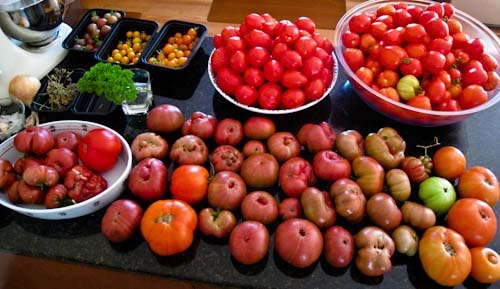
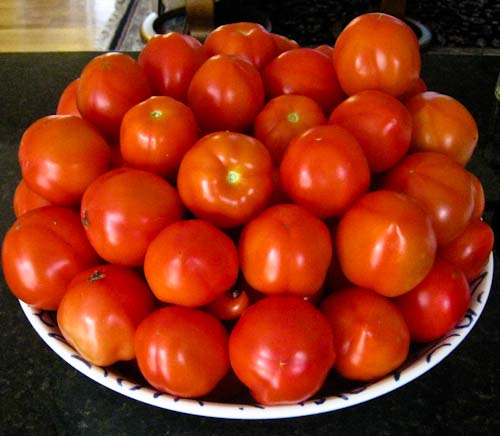
My counter that is. Tomato season is in full swing here. Right now the tomatoes own half of my counter. I've got Cherokee Purple, Purple Calibash, Market Miracle, Amish Paste, Sungold, Black Cherry, and the massive pile of Heinz in the bowls.

Cherokee Purple left, Purple Calibash right

Cherokee Purple continues to be my favorite of the large tomatoes. Purple Calibash isn't bad, but it isn't as prolific, not quite as good tasting, and a lot more weirdly shaped. It may be fun seeing weirdly shaped tomatoes, but using them is much more of a pain. Smooth more normal shaped tomatoes are easier. This year the Cherokee Purples in the back row just aren't growing as well as they did last year. The plants just stopped growing at about four feet. Last year you couldn't stop the vines. I don't know if it was being behind another row of tomatoes and not getting enough sun (which I won't do next year). Or if it is the weather. But I hacked back one that was accidentally put in the front to keep it in bounds and it just can't be stopped. It wants to keep growing. It just doesn't have the cage for it. So for next year I'll keep Cherokee Purple and give the boot to Purple Calibash.

Usually Market Miracle is 8oz and more perfectly round

My Market Miracle tomato is my one red tomato in the garden that isn't a paste. It isn't particularly early. Cherokee Purple tends to produce before it does. But it seems to always produce for me no matter the weather. No matter if it is hidden behind other foliage or in the shade of the neighbor's fence, or getting rained on all year. Unlike the Cherokee Purple, it is still growing strong and setting new fruit. It is right up against the fence and in the back row of tomatoes. Yet still it produces. I've found it tolerates partial shade better than any other tomato I've grown. It grew well this year during the heat. It grew well during the summer of '09 when we had constant cool weather and rain (that year it was the best producer). So it continues to have a place in the garden. It tastes good, but isn't up to the standards in taste of a tomato like Cherokee Purple. I have a neighbor I gave one transplant to. He planted it in a place which I'm guessing gets about four hours of sun. It is setting tomatoes. Not quite like mine, but still he will have home grown tomatoes this year. Then again Laura is growing it and it hasn't set yet for her. But for me it works.

Not quite ripe Amish Paste left, Heinz right

The two paste tomatoes I'm growing are Amish Paste and Heinz 2653. The Amish Paste tastes fabulous just like last year and is just now getting started as it is a pretty late producing paste. As you can see it is a huge paste tomato where Heinz is a very small one. Amish Paste just tastes too good to get rid of even though it is such a late tomato. I'll grow a couple plants again next year.

The Heinz I'm not happy with this year. The taste is just so-so even though last year it was one of the best tasting tomatoes. If I had another paste tomato that acted like it, I would replace it in a heartbeat. But I keep it because of what you see above. The plants are almost finished producing and it is still early August. It is a super early determinate paste. Here that is good. All we need is a bad year and getting the tomatoes to ripen would be challenging. In a good year I have time for succession planting or at the very least a cover crop. I worry about it though. It seems very susceptible to the leaf spot we have around here (I'm guessing septoria leaf spot, but who knows, tomato spot diseases are numerous and hard to distinguish). So would it really survive in a bad year? It is always the sickest tomato plant in the patch. Anyone know of a really good early determinate paste? It actually isn't the determinate that matters. It matters if it sets its fruits all at once. For instance Bellstar is an early determinate paste, but it ripens fruit over a long period, which isn't what I want when I can. I might try Grandma Mary's since at least it is early. I think I need yet another paste tomato trial next year. I'll probably put in Heinz again next year, but not so many. I'll give it another chance.

Wednesday, August 3, 2011

Bacterial Spot

I've been struggling with bacterial spot on my peppers since I was stupid enough to bring in an infected six-pack from the garden center. I always hate finding a new disease because I don't know yet how to fight it. Or if it is even possible to fight. Everything I read about the disease says my yields would be severely reduced. And the pepper fruit could be affected by the disease.

One control strategy was to pick off all the leaves that I saw that had any sign of the spot. I was doing this once a week, but it seemed that I was doing the plant more harm than good. It is hard to tell if the disease spread to new leaves is fast enough to warrant defoliating the plants once a week.

I would often get pepper drop after picking the leaves off and often not small little ones just setting, but half sized ones. So this week I left them on. I think next week if I haven't seen any massive spread, I'll pick out only the ones that are severely infected, but leave the rest.

Wednesday is always spray day provided it doesn't rain, which is my main line of defense against bacterial or fungal diseases. The typical spray that people would use for such things is copper sprays. Constantly using copper sprays in the garden can upset the micro nutrient balance of the soil. I tend to stay away from them. In addition the research that I've been doing says that bacterial spot is no longer controlled much at all by copper sprays. The bacteria has developed a resistance to it. I use Serenade. It is a bacteria that fights off other bacteria and fungi. I like it because it is non toxic. You will notice however that I use a respirator when applying it. And a full body covering that gets washed afterwards. And safety glasses (after spraying myself in the eye once, I always use eye wear when I spray). Though the spray itself isn't toxic, anytime you are exposed to large amounts of protein, especially inhaled, you can develop allergies to it. The last thing I need is another sensitivity. So I'm a good girl and spray safely. Though I always wonder what my neighbors think as they watch me in this get up.

Scotch bonnet with perfect leaves

Interestingly enough this bacteria is species dependent. Most of my peppers are Capsicum annuum - sweet and chili peppers. All of them have spots. But I also have scotch bonnet peppers which are Capsicum chinense. These are not affected at all. I have not one little spot on them. And I don't even spray them any more. They are immune. The Tabasco peppers on the other hand are Capsicum frutescens and are affected. In addition some peppers are just plain more resistant. The serrano peppers are growing well. The early jalapenos are having more problems.

Tabasco peppers, spot can be seen at the bottom left leaf

I also discovered that spraying with fish emulsion seems to help them out. It could just be because they grow faster that way and outgrow the disease a bit. But it could provide a bit of assistance. So I went to the internet to see if there have been studies on it. And lo and behold, someone did a study with neem oil and fish emulsion. Fish emulsion helps just a little, but neem oil is more helpful. Now I don't have any neem, and buying a lot of sprays to put on my peppers is not all that worth it. The peppers just aren't worth tons of money to deal with. And I like to keep my life simple. Though I am interested to see what Regalia might be like. It seems like a very interesting spray. It turns on disease fighting genes in the plants and works on all the things I have problems with. It is an extract of the giant knotweed. Hey knotweed is good for something! But like the aspirin I spray on my tomatoes early in the season, it is a better preventative than a cure. Maybe I'll get this next year to deal with my fungal issues. I like the idea of making the plant fight its own battles. And I don't have to spray every single week.

So the peppers are doing OK. They sure do look pretty, but so much foliage has been removed already. Many midsized peppers have been lost. I see some peppers starting to get bacterial spot on them. I don't like green bell peppers. I like red peppers. Though some are starting to turn, that process can take weeks and weeks. Do they have weeks? I don't know.

And now they have a new threat. The leaves of the Anaheims (mostly) have started to show signs of something. Mosaic virus? The neighbor that shares that side of the house with me does smoke, but I usually think of mosaic virus as mottling the leaves too not just puckering them. He also sprayed Roundup along the fence. But I didn't notice any of the leaves near the fence with any issues. I think he was pretty careful about spraying. And these are in the middle of the patch not near the fence. What else can cause this type of puckering? Well soon it might be time to rip them out.

And just to put the icing on the cake last night it hailed on us. At least we got almost an inch of rain to go with it. Of course it was after I had already watered the garden. The hail wasn't that bad as it didn't last long. The sunflower leaves seemed to get the worst of it. The poor peppers got a few shredded leaves. My first thought when I saw the hail start was, "what can I throw over the garden?" I really wanted to protect everything. I should look at the bright side of it all. The lettuce usually gets it worst and the lettuce was all dead from the heat already. Some days you just have to laugh.

Tuesday, August 2, 2011

Let The Canning Season Commence

OK so I've already canned some jam. It really didn't count as they weren't my peaches and they weren't my blueberries. I had to buy them at the farmers market. But yesterday I canned my first tomatoes of the season. I had piles of Heinz on my counter and since I'd just picked piles more, they had to go. Last year Heinz was my favorite paste tomato. It was so delicious. This year they are just OK. Nothing special. The Amish Paste this year has them beat by a mile. At least to me. I had some neighbors over last night for dinner and their little girl kept eating the Heinz. I was saying they weren't the best and not quite ripe (I'd used all the ripe ones for sauce making). But she disagreed with me. I'll have to bring over some real tomatoes for her this coming week.

So at 9:30am I started washing tomatoes. Then I quartered them and tossed them in my huge stock pot. I only cooked them enough to soften them. To sweeten up the pot since the Heinz weren't so good this year, I put in some Amish Paste, Cherokee Purple, Purple Calibash, and some cherry tomatoes too. The cherries especially can sweeten up a sauce. I don't want to use too many since it would take forever to boil them down. They are very moist compared to a paste tomato.

Then I ran them through my Victorio strainer. The gadget is ancient and the screens tend to rust. I would really like a new one that doesn't leak all over and make me clean the rust off of it before I use it. I'm sure someone makes one with a screen with good stainless steel.

I had a nice photo of the sauce boiling down on the stove, but almost every photo I took of that area was blurry. That corner of the kitchen tends to be dark. I used two pots to start with. I could have fit it all into my 12 quart pot. I think I had about eight to nine quarts total, but they boil off and thicken faster if I use more surface area. I boiled until the sauce started to get thick. Sadly the jars weren't ready yet. I had the canning water boiling; the lids boiling; the sauce ready. But the dang dishwasher needed 15 more minutes to finish up. It is how I sterilize and heat up my jars.

But when they got out I started filling them up. You might notice some white powder in the bottom of the jars. That is citric acid that I use. A lot of people use lemon juice but I never have. So this time I tried it with one jar. I added it to the bottom of the jar. Then ladled in the hot sauce. With a sterile spoon I mixed it up and tasted it. Well it tasted like lemon juice to me so the rest were made as usual with citric acid. And it will be interesting when I get that jar randomly. I don't know which one it is. So something is going to taste a bit like lemon juice.

Then they were canned. They were put in at about 12:15 as you can see on my clock. 35 minutes later they were done. I always wondered how long it took me to do a batch. Now I know. If I time the dishwasher right it takes just over three hours.

It is a lot of time, though I'm not really working except for the washing and straining. But an hour's worth of real work for seven little jars. Sometimes I think I'm a crazy person. Sometimes it is better not to look at the numbers. I've got a lot more tomatoes to can yet this year.

Monday, August 1, 2011

Harvest Monday - August 1 2011

Monday I took a photo of the harvest, but the basil leaves were covering all the pretty parts.

So I had to take another.

I also had strawberries on Monday. I always forget to take them with my other produce. I usually remember to pick them right before breakfast, so they don't get their photo taken until later.

Tuesday Harvest x 2. Tuesday had the first harvest of potatoes. They are Yukon Golds.

Wednesday Harvest x 2

Thursday Harvest x 2

Friday I took all the lovely photos of my harvest, but I didn't have the flash card in the camera. Doh! So I retook the photo of all the tomatoes I had harvested. It was a big tomato day. And again by the time I had harvested my strawberries. I'd already figured out my error.

But corn was picked the first time and not photographed. I didn't want you to miss the first of the corn photos. And really they are better with the husks removed. Dinner was a grilled burger from Chestnut Farms on a homemade bun, home made refrigerator pickles, salsa made with garden produce, grilled peas (these were mine from a couple of weeks ago, they were the last of the peas in the fridge), and of course grilled corn. The corn was two different varieties. Spring Treat and Shasta.

Saturday Harvest

Sunday Harvest

Sunday started the harvest of the dill seeds. As they ripen I put them into a bag to finish up when they are about as ripe as above. If I rub the seeds with my fingers they will fall off, but most of the head is still intact. I'll continue to harvest them for weeks as the different heads ripen. They won't get weighed until then. I use dill seed not for planting. The plants will put enough self sown seed into the soil for that. But I use them for pickles.

Sunday was also the big coriander harvest. It took me an hour to separate all the seeds from the heads. Usually such long processing would be done inside in front of the TV, but these are really really messy. So I took my muslin that used to shade my lettuces and used it to make sure I didn't lose any seeds. I can't get all the seeds off and be quick about it, but the plants and other refuse after partially cleaning the seed got dumped under the sunflowers where I want my coriander next year. There is plenty of seed in there to start a good stand.

I'm guessing I'll have about half a pound of coriander seed once it is dry. I won't weigh it until then. I've never had a harvest this large before. These put out an amazing amount of seed. What will I do with it all? I'll obviously have to start using coriander more than before. Which will be good for me, because coriander seed is an herb rich in phytonutients.

  • Alliums 2.23 lbs
  • Beans 1.24 lbs
  • Broccoli 0.61 lbs
  • Carrot 0.25 lbs
  • Corn 2.39 lbs
  • Cucurbits 7.16 lbs
  • Eggplant 1.81 lbs
  • Greens 0.94 lbs
  • Herbs 0.58 lbs
  • Pepper 0.10 lbs
  • Potato 3.65 lbs
  • Tomato 27.27 lbs
  • Weekly Total 48.23 lbs
  • Weekly Spent $0
  • Yearly Total 212.67 lbs
  • Veggie Garden was worth $239.03
  • Fruit 1.69 lbs

Harvest Monday is a day to show off your harvests, how you are saving your harvest, or how you are using your harvest. If you have a harvest you want to show off, add your name and link to Mr Linky below.