Sunday, June 21, 2015

Brussels Sprouts

I'm constantly being shocked this year by my Brussels sprouts. I've tried growing them before many times. Never successfully. The best I've ever done has been small pea sized sprouts. But this year the plants are huge.

For plants I don't know much about I start by using "How to Grow More Vegetables" by John Jeavons as s guide for plant spacing. But many times experience tells me that his spacings are too close. For instance when you plant onions in a grid 4" is a bit too close to let them really size up well. He says broccoli needs 15". I think 16" is a bare minimum and I currently give them 19" x 24" which gives me a better harvest. This year each Brussels sprout plant was given a 2' by 2' spot which they have totally filled out. Their leaves are now overlapping. I'm glad I didn't follow his 18" suggestion. For those of you who grow Brussels sprouts, what spacing do you use?

I underplanted the middle and the edges with my extra onion plants. I figured they would grow until the Brussels sprouts needed the space then I'd pull them. I really thought the would size up first though. The onions aren't very large. Maybe the size of a very small bunching onion. But any onion now is nice so I'm happy for the harvest. I took out the middle rows. As soon as these are eaten I'll work on the outside rows.

It is exciting to see little sprouts starting to form. If the plants don't have some horrible disaster, it looks I might actually get something this year. Of course it is far from certain. I have two worries. One is that the plants will outgrow their row cover. I suppose I can sew more on if necessary. But I have hordes of white butterflies dancing in my garden. I want to keep them covered. The other issue is where it is growing. That spot gets some serious shade in the fall. Will it have enough light to produce when it needs to?

Saturday, June 20, 2015

Broccoli

I picked my first broccoli today. The heads are huge. My hand width from thumb to pinky is 8" (20cm) wide.

Sadly though the heads aren't perfect. Some have brown spots in the middle and some are fairly lumpy, not smooth like most of the heads. I'm guessing this year's weather is responsible. The broccoli grew very fast this year. Like many things this year I'm picking earlier than normal. I know it seems weird that it is early since this year was the latest by far that the garden got planted. But the weather has been seriously warm this spring. It isn't unusual to get warm spells, but they are usually followed by really cold weather. We didn't have much of the cold.

Most years I also get a lot of hollow centers in the stems of the broccoli. I like eating the stems so it is a problem. It doesn't happen for my fall broccoli. This year it is almost non existent. Again I think it is the warm weather. So it has at least helped on that front. Even if I have brown centers on my broccoli heads.

This year I decided to save the leave of the broccoli. They are supposed to be very high in calcium. And good for you like all other brassica leaves. I'd never tried them before. And as you can see I cut my broccoli fairly low. So I can harvest all the leaves on the stems. I harvest them so low, not just so I can peel and eat the stem. But because I like to leave not too much on the plant. If I'm going for side shoots, I'll get bigger ones if there aren't a lot of them.

I blanched and froze some of the leaves, but kept some to eat tonight and I tasted them. They are much like kale. All in all a decent replacement for it. I'm contemplating freezing them in blocks with my kale as I'd use them the same way. I don't need to know which is which.

Each head was about 1 1/5 pounds. And each head had about 1/3 of a pound of leaves. Not too bad. I did remove the rib of the leaf though as it is tougher than the kale ribs.

And as a quick side note, I was out in the garden showing it off to a friend. I was not pleased to see the first squash vine borer flying about. Is it that time already? I usually think of July 4th as being the season, but here we are earlier here than my last garden. I checked the GDD50 and today we hit 950 here. So yup, it is that time. Currently my zucchinis are under cover, but they won't stay small long. I wonder if I'll have to remove it (or they remove it themselves) before the borers are gone.

Taste Test

Both my kimchi and my sauerkraut were ready for a side by side taste test. First though you get their smell. Kimchi has an overpowering smell to me. When I've been to the local H-Mart (Asian food megastore), I always stay out of the kimchi wing. It is just too much for me. My own isn't quite that bad as it is just one jar, but still it is strong. Sauerkraut's aroma is a bit more subdued. Either aren't really all that bad right now as I can open the windows and the smell dissipates. But in the winter I might not like it much.

Kimchi left, sauerkraut right

As for taste. The sauerkraut is OK. Kind of boring. It was a bit too salty. So I'll try a lower salt content next time. But very edible. The kimchi surprised me. For something with such an strong smell, the taste was quite nice. I could see eating this on a regular basis. Of course anything that has an underlying taste of garlic and ginger has to be good. I think next time I might drop the ginger just a bit. The cherries really didn't add much either. But I liked the turnips and carrots in the mix. And the sweetness was just right.

My problem with the kimchi though is storage. This is a way to preserve cabbage for me. Well and get some probiotics. But the kimchi when it ferments really goes for it. I left about an inch on top of both the sauerkraut and kimchi. The sauerkraut raised up a bit, but not enough to overflow. The kimchi overflowed a lot. I poured some liquid out to help out. But it just did it again. It was a very vigorous fermentation. But since I lost so much liquid, once it had cooled off in the fridge, the liquid sunk down to about half way up the jar. So I have no liquid covering my kimchi. I think it is necessary to keep it from growing mold in storage if I keep it for any length of time. I'm thinking I could cover it with a fresh brine, but if I do what percentage do I make so it still tastes good? Maybe 2%? Anyone have any clue?

I'm assuming the kimchi is such a vigorous fermenter because of the sugar that was added. I didn't add as much as a lot do. And I didn't add that much fruit. Next time I'll have to leave a lot of space on top to keep it under control. It would be interesting to make a mix that was flavored like the kimchi (garlic, ginger, cilantro) but fermented more like sauerkraut. I might really like that and it might not have the smell or the out of control fermentation. It might be time to play with my mix.

Friday, June 19, 2015

Herb Circle

I've been wanting to rip out the sage in the middle of my herb circle for the last several weeks. But I couldn't bring myself to do it because of the wonderful blossoms it was putting out. Not only was it pretty, but it was feeding a lot of bees. Finally the show is over. The bees have moved on to the lavender. And I could get rid of the sage.

I took the newest of the sage leaves and am dehydrating them. The rest got composted. Sage is a very much loved herb here, especially in the winter. We eat a lot of chicken soup then. And never fear I have four other sage plants in the yard. I won't be short on sage without this one.

The reason I wanted to get rid of it is because it is way too big for the space. It didn't mind. But the herbs on the north side of it were struggling. I had five marjoram plants there and one up and died. One is very yellow as it saw no sun at all. And the others were desperately reaching for the sun. I'm really shocked the winter savory plants that were covered survived so well. But they are looking pretty good. I might get a decent harvest from them later this year.

I moved an Arp rosemary to the middle of the circle. I know that in some climates rosemary can get huge too, but here it tends not to. If we get a really mild but snowy year I'm sure it will be annoyingly big too. But I won't care. I don't get nearly enough rosemary for my liking. I'd make rosemary bread every week if I could, but I just don't have enough for that. And rosemary chicken. Yum.

The empty slot left by the rosemary used to have garlic chives in there. They are trying to come back. I however planted some more basil under the lights, so I'm going to plant them there. I won't pull the chives but let them battle it out.

The next chore will be to control the oregano. It always tries to take over its neighbors. I usually let it bloom for the bees too. But I think I might not this year. I might cut it back to keep it from blooming. The little oregano seedlings are just everywhere this year.

Thursday, June 18, 2015

Preserving the Greens

I've read some posts recently about how people preserve their greens. Mostly it is all the same. Wash, blanch, cool, freeze. The differences are all in the details. I've found over the years what does and doesn't work for me. And some of what I do is a little different from the norm.

Four gallon wash pan

Washing seems simple. But it is really trimming and washing. I do most of my trimming outdoors at the same time that I pick. This makes the whole indoor time shorter. I like being outside most of the time. Here you see me washing my chard. However there are no stems on it. Those were removed while I picked. Any large annoying things are picked off too, like insects or the ever present maple barf that keeps coming down from the trees. I think that is over at least. Though I'll be pulling a lot of little maple seedlings soon. I always pick with a bucket by my side to toss in any waste. And anytime I'm under a row cover I weed around the plants. Once the greens are brought inside the leaves don't need much more than a quick rinse. Though I use a very big wash pan to make washing easier and I harvest right into my wash pan. And when I'm done with the water it gets tossed on my raspberry plants. They love the extra water.

Blanching is pretty easy. Toss the washed greens into a large pot of boiling water for 2-3 minutes depending on the crop. The difference comes when I remove those greens. I don't put a colander in my sink an pour. I have a really nifty tool to remove the greens from the boiling water. The water stays on the stove. I often do more than one batch at a time. If I put too many greens into the water at once the water never gets back to boiling before the time is up. It cools it down too much. So I do about 1 to 1 1/2 pound batches at a time. As soon as one batch is removed the next batch goes right in. For me, throwing hot water down the sink between would be a horrible waste of hot water not to mention my own time. Water takes a long time to boil.

I'm pretty typical on cooling my greens. A pot of ice water. Some people use their kitchen sink with ice in it. I cringe at that. Kitchen sinks have the most bad bacteria of any place in your house. I cut open my packets of raw chicken in my sink. I don't want to contaminate my nice greens. I often eat them by just thawing them out and eating them cold. I love cold greens (yes I'm weird that way). I do have to say though, now that I'm blanching a lot I've found I'm in love with my ice maker. I thought it was an irrelevant item when we bought it. But we couldn't get it without one. Now when I'm in big time blanch mode in the spring, I always have ice.

Once the greens are cold I put it into a mini loaf pan. Each one holds about a serving if I mound them up a bit and compress them. I like that they are rectangular. When I store them they take up less space in the freezer. These go on a cookie sheet and into the freezer for about five hours.

They are unmolded and 12 of them are stored together and vacuum sealed in a bag. I like these packets better than what I was doing last year which were individual packets. They take up a lot less space in the freezer and use less plastic. Though in 6 months we will see if the blocks still separate easily. I think they will.

If I eat only from the garden over the winter. I need four of these squares a day for me. I tend to eat two cups of greens each day and two cups of orange, white, or purple things. Right now I'm eating more like three cups of greens, but it is greens season. Color is harder to come by. I'm not getting things like sweet potatoes, squash, cucumbers, or carrots quite yet. So each packet represents three days if I never leave the house for food (I don't often), never buy food from the store, and I eat my vegetables like I should. Say I have four months that I need over our frozen winter. I'd need 30 packets. Ouch! That is a lot to store. I'm thinking with my current diet I won't get enough stored for the winter, but I'll do the best I can. So far I think I have 15. So about half way there.

Turnips are frozen differently than my greens

Greens aren't the only thing I've been freezing. But the others are small bits here and there. I've been freezing my strawberries when I have extra. Though I think they have started to slow down so not much more will be frozen on that front. Those I froze in half pound segments as I use them in my smoothies in that quantity. I froze a couple pounds of turnips when I had that big batch from under the broccoli. Slowly but surely the freezer is filling up. As is typical though I won't have enough to last the whole winter. I'll try but the garden isn't quite big enough for that. Nor is my freezer for that matter.

Tuesday, June 16, 2015

When it rains

When it rains I tend to do my indoor chores. Several of them involved new recipe for my garden fruits and veggies.

The first was strawberry chutney. It was pretty good, but I didn't like the amount of cumin in it. Too much. Next time I'm going to cut it down by a quarter or maybe just get rid of it all together. This wasn't a recipe to can, but just one for the fridge so I could play with it and not worry if it was acidic enough. Which is nice as I like to play around with recipes. I rarely take a recipe and follow it. I'm more likely to read 10 recipes and take what I like from each one. Or add something else.

The second was some kohlrabi fermented pickles. Katz suggests a 5% brine for your first try. So that is what I did. For me that was 1.5 tablespoons of sea salt to two cups of water. I put some herbs and spices on the bottom. Some dill, garlic, mustard seed, and dill seed. I packed the jar as tightly as I could with kohlrabi spears about a quarter of an inch thick. Then poured over my brine. I capped the top with part of a kohlrabi leaf and put on my weight. I used an airlock. I'll taste them in about three days to see how they are.

Brining the cabbage

The kohlrabi was easy, but I wanted to try making kimchi. It is a bit more daunting. I read up on it a bit to try to get an idea of what I wanted. Kimchi involves brining vegetables for 3 hours to a couple days depending on the salt content of the brine. Then you rinse it off once the vegetables are salty enough. You make a paste with rice flour cooked in water. You add seasonings to the paste. You massage the paste into the vegetables. Then you ferment it for a few days. That is so much more involved than something like a pickle or sauerkraut.

The recipe I'm giving is the one I used, though it is my own mix of things that I thought sounded good. I have no clue how it will turn out. But my hands smell really good right now, so I'm hoping it turns out well. I didn't use a whole cabbage. I didn't want to do that for my first try. So I used two pounds, which is about half a cabbage. I don't have diakon radishes, much less the Korean radishes, so I used my turnips instead. Also I can't eat peppers, so mine is not spicy and it won't have that pretty red color. I thought about using some of the last of my other radishes up to give it a pink color instead, but opted not to.

My weirdness in this recipe is dried cherries. I've never seen a kimchi with them. I have seen one with raisins so I figured it can't be too crazy. I would have loved to put an Asian pear into it instead of honey, but I didn't have one. I did have an apple but it has been sitting around my fridge for a while. I figured fruit that has seen better days is better for cooking than for fermenting.

Daphne's First Try Kimchee

  • 2 lbs Chinese cabbage sliced in 1/2" strips
  • 4 oz Japanese turnips julienned
  • 1 carrot julienned
  • 3 T salt

  • 1 T sweet rice flour
  • 1/2 c water
  • 1/4 c white parts of green onions
  • 1" length of ginger grated
  • 2 cloves garlic
  • 1/4 c cilantro
  • 1/2 T fish sauce
  • 2 t salt
  • 2 T honey

  • 1/2 c green onions (green part) cut into 1 1/2" length then quartered the other direction
  • 1/4 c dried cherries, chopped

Mix the first four ingredients together. I put it in a 2 quart mason jar but any non reactive container is fine. Cover with water and weight it down. Let it sit for six hours.

To make the paste dissolve the rice flour in the water and cook until it becomes gelatinous. Let it cool. Mix all the rest of the ingredients in that group (through the honey) and put it in a small food processor and process until smooth.

Mix everything together in a bowl. Then tamp down into a quart jar until the liquid comes to the top and over the vegetables (if it doesn't let it sit a couple hours and try again). Put a cabbage (or in my case a kohlrabi) leaf over the top to hold things down and weight. Cap the jar with an airlock. Let sit for three days then move to the fridge and enjoy.

I had about a cup leftover from this. The recipe would probably be more accurate for a quart jar with about 1 1/2 lbs of cabbage. But the extra cup won't go to waste. I put that in a half pint jar and put a lid on it. It wasn't an airlock. Currently I only have wide mouth lids with holes for airlocks. I might have to get a few for smaller jars. I could see doing a pint of turnips some day. Or maybe carrots.

Now they sit decorating my dining room. They are right next to my jars of seeds. Mustard seed, fennel, and dill. I'm going to test the sauerkraut again on Thursday I think. I just hope I like it. It was kind of salty the first time I tried and not nearly sour enough for my tastes. Oh I hope I like these. It is an easy way to preserve a lot of cabbage.

Monday, June 15, 2015

Harvest Monday, 15 June 2015

Last of the tatsoi and bok choy

Last of the mizuna

Last of the spinach

There were a lot of lasts this week. My baby Asian greens bed was ripped out to make way for corn and squash. Ditto for the last spinach bed. The photo below shows the last of my basil taken down by mildew.

I still had plenty of old favorites like chard, lettuce, and kale. But some new crops came out. I harvested the garlic scapes. I think I have them all picked. Some hide and are hard to see.

Also in the new category were the first raspberries and snowpeas. My townhouse mates will be the recipients of the peas as I can't eat them. The raspberries are just starting. We have a tiny little patch between the bulkheads of the two townhouses. I don't get to weigh them all as whoever is out gets to pick and eat them. They often don't make it inside. Sometimes though there are ripe ones in the morning and I'll snag them for breakfast.

I had three really big harvests this week that need to be preserved in some way. The first are the turnips. I picked them in several different beds at several different times. I tend to underplant the brassicas with them, so some came from the broccoli patch and some from under the Chinese cabbages.

And then there were the Michihili cabbages. This form of Chinese cabbage gets really tall. I was introduced to them by Mac years ago (thank you Mac!). This variety, Green Rocket, gets to be about 20" tall. I picked five of them this week for a total of 19 pounds. One went to my townhouse mates. I may freeze some for soups in the winter. But not a lot as I find I don't use a lot. I think I might try my hand at a non spicy kimchi.

You might notice that I trim my Chinese cabbage a bit strangely. The outer green leaves are course (though they do make good soup) and I trim them off. But the white rib is still wonderful for eating raw or cooked. So only trim the outermost layer off then keep the rest of the ribs. The ribs really are my favorite part.

The last major harvest was my strawberries. I picked a lot of bowls of strawberries this week. I think this is the peak week at 11 lbs. I froze some earlier in the week and today I'm thinking of making a strawberry chutney/sauce. I used up the last of my plum sauce yesterday and I need a replacement until plum season. Strawberries might fill the gap.

  • Alliums, 1.98 lbs
  • Greens, 5.55 lbs
  • Greens, Asian, 22.54 lbs
  • Herbs, 0.34 lbs
  • Roots 6.29 lbs
  • Weekly total, 36.86
  • Yearly total, 128.33 lbs, $141.08
  • Fruits
  • Strawberries, 11.06 lbs
  • Raspberries, 0.11 lbs
  • Fruit Yearly total, 8.09 lbs

Harvest Monday is a day to show off your harvests, how you are saving your harvest, or how you are using your harvest. If you have a harvest you want to show off, add your name and link to Mr Linky below.

Sunday, June 14, 2015

Problems and Failures

You have to be a pretty optimistic person to garden. Taking a tiny seed and expecting it to become a four pound cabbage takes a lot of faith in mother nature. Every time I plant, I believe in that miracle. I never lose the wonder when it does grow, but sometimes we have failures. They aren't uncommon. Either our own mistakes get us or nature deals the blow. This week I had a some of both. Nothing devastating like the year the earwigs ate all the silks off my corn (only once, and never before or since thank goodness). Or the year the groundhog ate all my winter squash. Ouch. But this week had quite a list of little problems.

Turnips under a good row cover

Turnips seem to be getting the brunt of it right now. You know how I was doing such a good job with my succession sowing? Well this week I totally forgot until Sunday. I'm supposed to plant every Monday. Whoops! Well one week missed is not the end of the world. But for the poor turnips that wasn't all.

Turnips elsewhere struggling

At my last house I had a lot of issues with flea beetles, but they have been pretty mild here. They exist but don't do a lot of damage. Until now. They are doing enough damage to kill some of my newly sprouted turnips.

I don't spray here (except soap when the aphids get bad on the kale and broccoli), so my only recourse is to try to catch them. I won't catch them all, but the hope is to get enough that the damage won't hurt the plants too much. I brush the plants trying to get them to hop in the soapy water. I'll leave some of these bowls near the damaged plants. Over time some will die. Every day I'll chase more in. Hopefully it will be good enough.

In the other half of the bed with the turnips are my parsnips. Not many parsnips. Half the bed barely germinated and the half that was better is by no means full. I no longer have time to resow parsnips. They just take too long. If I had seed I'd use half that section to sow in amaranth. I've never grown that before. I think next year I'll try it. I could do mizuna but those flea beetles would probably take them down too. Maybe I should inter sow carrots. They have plenty of time. I will have two other carrot beds in the fall though. Will that be too many carrots? Is there such a thing as too many carrots? The issue with carrots is their germination is just as problematic as parsnips. I usually use a doubled over row cover on the soil to keep it moist. I can't do that with the parsnips growing. I could use one layer, or maybe just try without and hope. I'd have to water a lot.

Basil was one of the worst failures. I planted in three spots to try to avoid the basil downy mildew. That worked last year. One section went down fast, but the other was mildew free for most of the year. All three spots got hit already. So they all got taken out. Sigh. I did get a small harvest from the last one out. It was enough to dry so I can make Italian seasonings for this coming year, but not enough for much else. I do still have time to start again. Do I want to?

Chard bed

I love chard. It is such a good grower. I'm always amazed at the harvests I get from a small patch every year. One plant got pulled as it looked like it was starting to get diseased. I grow Argentata and it seems to handle the diseases we have around here. But safer to pull the bad one that isn't resisting so it won't spread. Also one end was getting holes in the leaves. I have this trouble every year. The earwigs take up residence in the centers and eat holes out of the youngest leaves. They can take a plant down if they get too numerous, though they usually don't.

Earwigs freak me out a little, but in the garden they can be a help and an hindrance depending on the crop. They are omnivores so eat other insects but if they like the crop they also eat that. I just don't grow Napa cabbage anymore because of the damage they do to that. Michihili cabbage works better. Sometimes they get in, but not as much. For chard I go on a search and destroy mission with my knife. They hide where the leaf meets the stem. I poke the tip of the knife down in there to get them. I won't get them all the first time. I'll go out for the next few days to get the rest. Then keep vigilant for the rest of the season. I used to mulch the chard to keep the leaves clean, but I found the earwigs had too many places to hide then.

The last one is in the Michihili/kohlrabi bed. Luckily it wasn't earwigs this time. Nope they started to bolt on me. I picked one earlier in the week that had started to bolt. Well I didn't check them for a couple of days and the next one did. So I picked them all. I was kind of hoping I wouldn't have to until next week. I'd probably be able to tell if my sauerkraut was working for me by then.

Chinese cabbage ready for the fridge

I stored most of them in the fridge. I wrap them in a damp flour cloth towel and just leave them in the main part. They are way too big to fit into anything. They are 20" long and have to go sideways in the fridge. They store pretty well. I can keep them fresh for about a month and a half to two months, but the problem is they take up so much space. And the other side of the bed is the kohlrabi. I think I have 15 or 16 of them in there. Some of them have sized up already and need to be picked soon. Winner doesn't get woody fast, but they are hard to cut when they get really large just because of their size.

And remember at the beginning of the month when I had the groundhog incursion? Well I shored up the defenses and it seems to be working. He hasn't come back. Most of the beans that he lopped off died, but four of them might make it. They have some tiny little green growth were the cotyledon leaves used to be. And the four seeds that I had left and replanted have come up and are growing pretty well. So I put up the strings to the trellis. The two plants that he didn't touch are growing strong and climbing the trellis supports. I think it was the trellis itself that saved them as they were behind the metal and harder to get to. So at least there is some good news there. My beans are recovering to an extent.

Friday, June 12, 2015

Consequences of Planting Corn

Rose arbor entrance to the garden

The other day when I was planting the corn I noticed some of the rose petals were dropping on the bed. Rose petals have been used for flavoring food for centuries. I've thought about harvesting some in the past, but never had. They are just too beautiful and smell divine in the garden. Cutting off the flowers seemed too hard. But I've been reading books on Middle Eastern cuisine. Rose not an uncommon ingredient and it seems a good cuisine for my food problems. Yes it uses beans, eggplant, and peppers, but unlike something like Mexican cuisine or Indian, I can eat most of the food with just mild changes. And I love the flavors. I never knew that mint and cilantro tasted good together. What would a rose taste like?

I only picked a handful to see how I like them. They certainly made one of my prettiest harvests. I pulled the petals off and laid them on my dehydrator sheets. I didn't use the dehydrator though. I'm just letting them dry naturally. When they are almost done I'll finished them off for an hour to get the last water out. Our climate is pretty humid and herbs (or rose petals I'm assuming) can mold if I don't use my dehydrator. The house smelled so good that first day. Heavenly.

While I was planting the corn I also noticed some white roots under the nearby row cover. I don't go down that path all that much and hadn't checked on them in a while. The row cover is over the broccoli, but I often under plant with turnips. These are Japanese turnips - Oasis - and most will tell you they are best picked at about 1" in diameter. I tend to like them just as much at 2" which is good as some were pretty large.

I'm glad I noticed them before they got way too large and woody. Strangely most of the turnips were ready to pick. Usually I'll find with turnips, especially under planted turnips, that they grow large sporadically. I rarely have a row of them ready at once. Much less a whole bed of them. Most were trimmed of their leaves, but I left a bunch on. Those I sent over to my townhouse mates. I figured they might appreciate the turnip greens and if not they will end up in my compost pile anyway.

These turnips were just lovely too. I often get some root maggot damage despite the row cover. In fact I lost one broccoli plant to them near where they were growing. But I think the flies like the broccoli more than the turnips. For the cabbages it seems to be the other way around.

While I was under there I got all the weeds out, though it wasn't all that bad. And I took off any yellowing leaves from the broccoli. And of course checked out how the heads were forming. They are looking good. It won't be long now. This one seems to be the farthest along. One though - damaged but not killed by the root maggots - hasn't even started to form. It is still trying to gather enough strength for it. It is about half the size of the other plants.

Thursday, June 11, 2015

Bearing Fruit Trees

Can you find all eight fruit trees in this photo?

We have eleven fruit tress on our shared property. But only two of them are really bearing right now. I do have another that is trying, but not enough to protect it from the squirrels and groundhogs, so the fruit probably won't last long. In the above photo you can see the two peach trees. The one on the left is only two years old. But the one on the right is five. It has given us fruit for two years and has a lot of baby fruit on the tree.

Crowded peaches

About this time I thin out the peaches. Usually I do it a bit earlier, but I've been busy. So some of the little peaches have dropped off the tree. I try to get all the little fruit up and into the compost. And any fruit that drops later. I've found it helps to keep the brown rot down. The first year I had lots of trouble with it, but if I keep it all clean I'll only lose a few peaches. Nothing worth worrying about. I don't spray the tree, so cleanliness is everything.

I thin to about 8" along a branch. But I'm not very even about it. Some times the peaches are right next to one another. Some times far apart. I like to pick the biggest and most flawless peaches to keep. Last year I had to thin out hundreds and hundreds of peaches. This year the chore was easier. The winter was harder and there were a lot of gaps on the branches. I'd be shocked if I didn't take off a couple hundred though. This Redhaven peach loves to produce fruit. I however like fruit that is bigger than a golf ball, so I thin.

My apple tree is not nearly so lovely. And it doesn't produce quite as much. But it did set a lot of apples this year. I thinned it out earlier on. The squirrels however were really enjoying my apples. Last year they waited until the apples were much larger. I thought I wouldn't have to net until July. The peach tree I can net myself since it is shorter than I am. The apple tree however is about 8' tall. I got my husband and two of my townhouse mates out to help. We put up step ladders on either side. So two people were up on top trying to lift it over while two people were down at the bottom unsnagging it and pulling it down. It was quite a production. Netting gets stuck on everything. And note to self - don't wear buttons again while netting the trees.

Energy bars, sandwich buns, and breakfast muffins

And having nothing at all to do with my fruit trees, I decided I'd better get the baking done as the weather was really warming up. Instead of my strategy of baking here and there as I need it, I looked at what I needed for the next several days and baked it all at once so I wouldn't have to heat the house up so much. I did it early in the morning too as it was still cool.

Wednesday, June 10, 2015

Fourth Corn Planting

My husband loves corn. I start in May and do five successions each about a week apart. I'm hoping the last succession will still be producing when my mom visits in late August. Sweet corn is one of her favorites. But the timing will be tight. I could plant it later, but I always do corn and squash together. We have raccoons in the area and they don't like walking through a field of prickly squash, so my corn is usually safe if I train the squash to grow under the corn. But I want the squash to have time to produce. I can't plant it much before the corn as then it would overwhelm the small plants. So mid June is about as late as things get planted up.

I'm on my fourth planting right now. It went into the baby Asian greens bed. On Monday I picked the last of the boc choy and mizuna. You see the outside leaves I trimmed off but didn't dispose of (I was hungry at the time). And all that was left to pick yesterday was the mizuna. Much of it was starting to bolt, so I wasn't too unhappy to see it go. I'm wondering where I could squeeze in a plant or two though.

The schedule said to plant the corn on June 7th, not June 9th. But it is easy to keep up even if you don't have time that day to plant. On June 7th I put the corn and squash into little covered bowls with some paper towel and some water. The corn and squash seeds had begun to send out little roots by the time I planted two days later.

This is going to be my mycorrhizal fungi experiment. On the northwest side of the bed the corn has been inoculated. But the southeast side has none. The spring experiment was a bust. Adding endomycorrhizae to the soil didn't improve the growth of lettuce or peas. But then it isn't supposed to do well in cool soil. You don't get warmer than in summertime, so this will tell me if it is worth the price to buy or if it is just a waste of money for me. For all I know I have plenty of these soil fungi already in my soil.

First succession

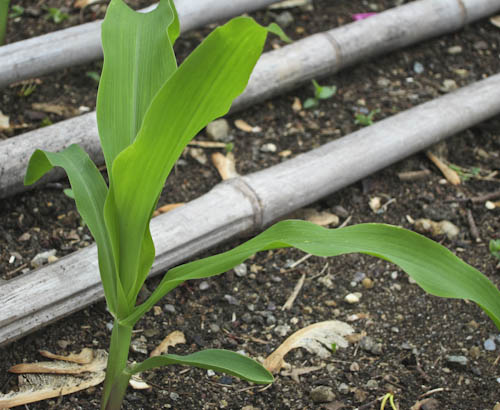
The other successions are up and doing well. I have one corn plant in the first succession that is struggling for some reason. And one of the two squash plants at the end of the bed damped off in May so it was replanted. That is smaller than its neighbor, but it will catch up.

Second

Third

The third one is barely out of the ground. The squash in that one isn't up yet. Now I have four of my successions done. I have just one left to go.